Why Design Education Should Begin Early in India: The Case for Grade 8?
Why should design education begin as early as Grade 8? Explore how design thinking builds creativity, empathy, problem-solving and future-ready skills for students in India.
For years, Indian students have been asked to make major career choices at the point when academic pressure is at its highest. By Grade 11, they are expected to choose a stream. By Grade 12, they are expected to prepare for competitive exams. But long before those decisions, students need the opportunity to understand their interests, strengths and way of thinking.
That is why design education should begin in Grade 8.
This is not about asking a child to choose a design career early. It is about helping every child become more observant, creative, empathetic and confident in solving problems—skills that matter in any future.
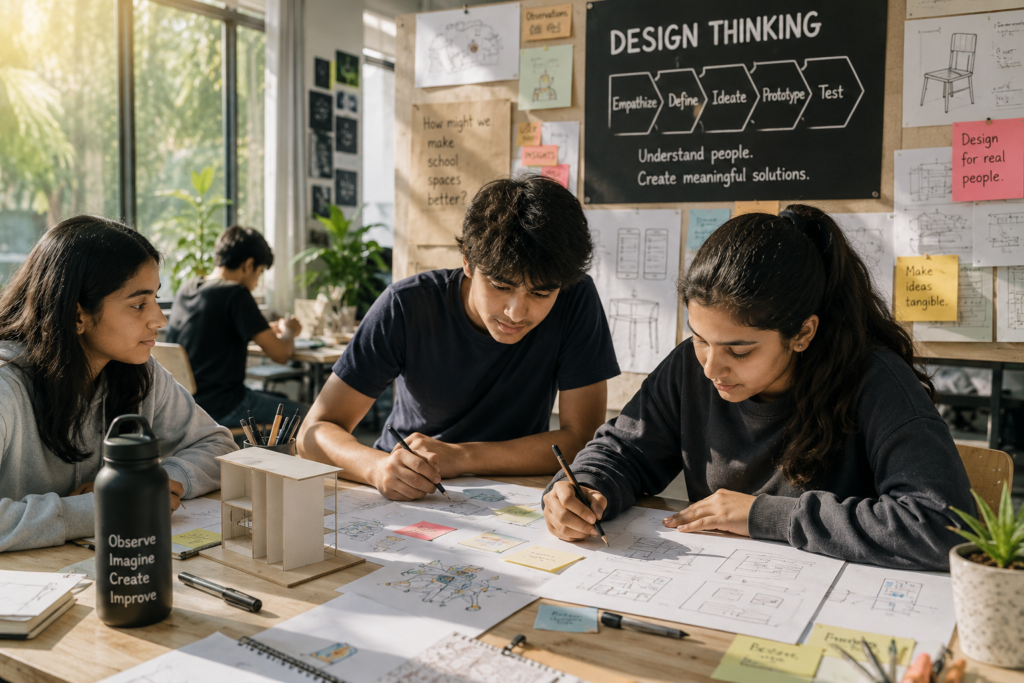
Design is not just drawing
When people hear the word design, they often imagine sketching, fashion or making something look attractive. These are meaningful parts of design, but they are not the whole story.
Design is the thinking behind the lunch box that a child can open independently, the banking app that helps an older person make a payment, the hospital experience that reduces a patient’s anxiety, the package that creates less waste and the public space that makes people feel safe.
It shapes products, apps, brands, interiors, transport, healthcare, fashion, games, learning spaces and public services. At its heart, design asks students to observe people, identify a real need, imagine possibilities, test ideas and improve them through feedback.
Why Grade 8 is the right time
Grade 8 is a powerful stage of development. Students are curious, expressive and beginning to form their own opinions about the world. They start asking bigger questions: What am I good at? What excites me? What kind of future can I build?
Yet this is also when learning can become increasingly focused on finding the one correct answer. Design education introduces an important balance. It gives students permission to ask questions, explore multiple solutions, make mistakes and learn by creating.
Beginning at this age allows students to explore without the pressure of an entrance examination, a portfolio deadline or a career decision. They develop confidence gradually—and make more informed choices later.
What leading international school systems do differently
Across the world, respected school systems have moved design beyond the art room. They include it because students need to think creatively, work across disciplines and respond to real-world challenges.
The International Baccalaureate Middle Years Programme, used for students aged approximately 11 to 16, includes Design as one of its eight subject groups. Students use a design cycle to investigate a problem, develop feasible solutions, create, test and evaluate their work. This places research, making and reflection at the centre of learning—not simply the final product. Learn about IB MYP Design
In England, Design & Technology is compulsory from primary school through Key Stage 3, which broadly includes the Grade 8 age group. Students design and make products for real users, evaluate ideas and draw from maths, science, engineering, computing and art. The national curriculum describes it as essential for participation in an increasingly technological world. Explore the UK Design & Technology curriculum
Singapore is embedding design thinking through project-based learning from the primary and secondary years. Its national Design Education initiative has extended design-based learning tools to all Ministry of Education schools, showing that the country sees creativity, collaboration and problem-solving as capabilities for every learner. Read about Singapore’s Design Education initiative
Australia includes Design and Technologies within its Foundation–Year 10 curriculum so that students can understand and work with the technologies shaping their world, while creating solutions for more sustainable ways of living. Explore the Australian Technologies curriculum
These systems differ in structure, but their message is consistent: design education is not a niche elective for a small group of artistic students. It is a way to help young people understand the world and contribute to it meaningfully.
Design thinking helps students in every career
The greatest value of design education is that it is useful even when a student does not choose design as a profession.
Design thinking is a practical way of approaching a challenge: understand the problem, consider the people involved, explore different possibilities, test an idea and improve it. This mindset is useful wherever people, systems and decisions are involved.
A future doctor can use it to improve a patient’s experience in a hospital. An engineer can create a product that is not only technically correct but also safe and easy to use. An entrepreneur can understand a genuine customer need before building a business. A teacher can make learning more engaging. A future lawyer, manager, scientist, civil servant or technologist can consider different perspectives before making decisions that affect others.
Students benefit personally too. They learn that a difficult problem may have more than one answer. They learn to accept feedback, recover from ideas that do not work and ask better questions: What can I improve? What did I miss? Who am I solving this for?
These habits build resilience, empathy and independent thinking—qualities that remain valuable long after school.
Why India needs this mindset
India’s future will be shaped by challenges that need more than memorised answers: accessible public spaces, sustainable consumption, safer mobility, inclusive digital services, meaningful education and better healthcare experiences.
Students need the ability to understand people and context, connect knowledge from different subjects and turn an idea into a thoughtful solution. A student who redesigns a school bag for comfort learns empathy and ergonomics. A student who studies confusing packaging learns communication. A student who improves a waiting area learns to consider behaviour, emotion and space.
These small projects teach a powerful habit: the world around us can be observed, questioned and improved.
Creativity matters even more in an AI-powered future
AI can generate information, images and options at remarkable speed. But it cannot replace human curiosity, judgement, empathy or the ability to decide which problem is worth solving.
Students must learn to frame better questions, evaluate options, collaborate with others and create responsibly. Design thinking builds these distinctly human capabilities. It helps students use technology with purpose, rather than simply consume or depend on it.
In an AI-powered future, creativity is not an extra skill. It is a way of thinking.
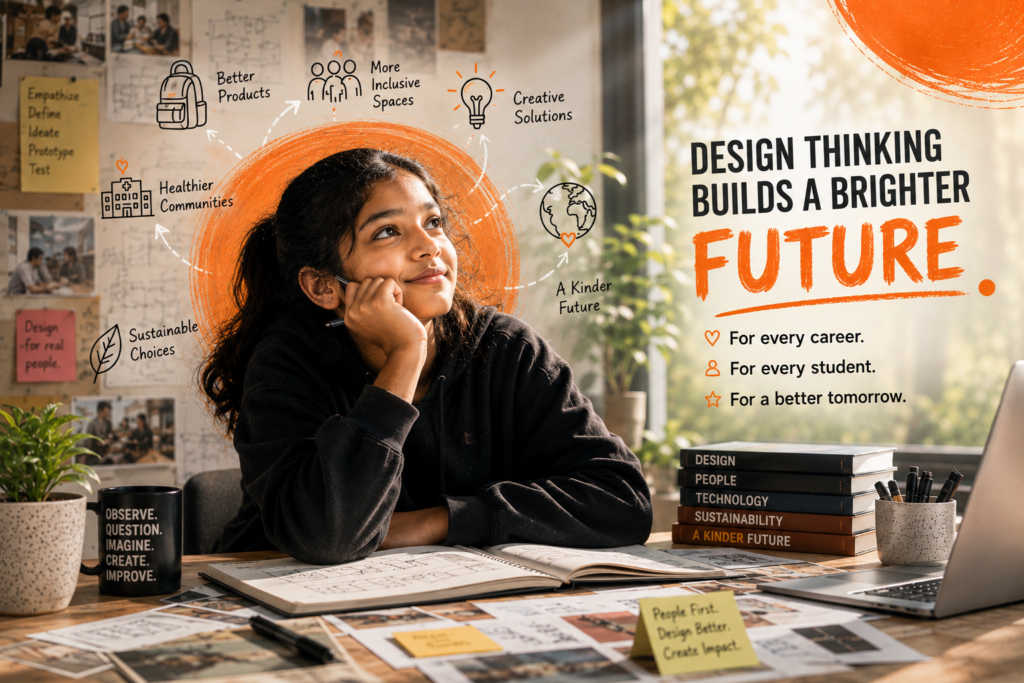
What meaningful design education looks like
Good design education for Grade 8 is not a drawing class with a new label. It is hands-on, reflective and rooted in real life. Students should have the opportunity to:
- notice design in everyday objects and experiences;
- understand different users and their needs;
- research, sketch, model and communicate ideas;
- work with materials and create prototypes;
- learn from critique and improve their work;
- connect creativity with science, technology, culture and sustainability; and
- explore many design fields before specialising.
The goal is not to make every student a designer. The goal is to help every student become a more thoughtful maker, decision-maker and problem-solver.
Explore before preparing with Studio Atelier
At Studio Atelier, we believe students deserve to explore before they are expected to prepare.
Our Grade 8 Design Discovery programme helps students observe, understand, imagine, communicate, create, explore, innovate, solve, collaborate and showcase. Through real-world projects, discussion, observation and making, students begin to see the world not simply as it is—but as something they can improve.
Whether a student eventually chooses design, engineering, medicine, business, law, technology, education or another path, these are skills they will carry for life.
Design education does not ask a child to decide their future early. It helps them become ready to create it.
To learn more about Studio Atelier’s Design Discovery programme for Grade 8 students, connect with us.