What Did a 12-Year-Old Notice That Everyone Else Walked Past?
A 12-year-old noticed what hundreds of people walked past every day. Vinisha Umashankar’s solar-powered ironing cart shows how observation, curiosity, and questioning everyday problems can become the starting point for design thinking.
Every day, hundreds of people may have walked past the same street-side ironing carts.
They saw vendors at work. They saw charcoal heating heavy irons. It was an ordinary part of everyday life.
But a young girl from Tamil Nadu looked at the same scene and wondered:
Could there be a cleaner way?
That girl was Vinisha Umashankar.
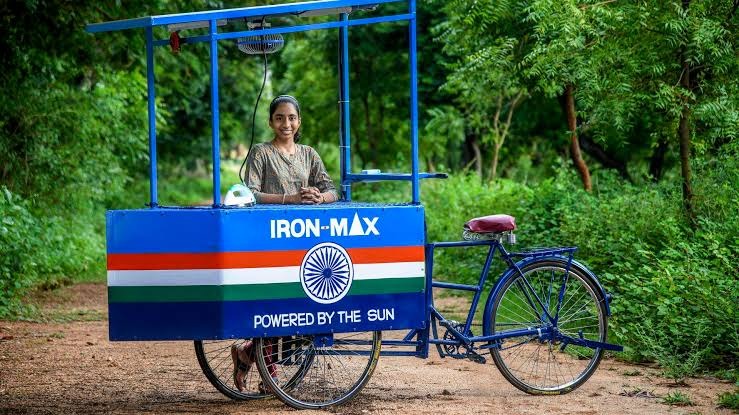
Her curiosity eventually led to the idea of a solar-powered ironing cart—an innovation that gained international recognition and took her journey all the way to COP26.
Her story is inspiring for many reasons. But for us as design educators, one part stands out in particular.
Before there was a solution, there was an observation.
And that is often where design begins.
She Saw a Problem Hidden in an Everyday Routine
When something becomes part of our everyday surroundings, we often stop questioning it.
A chair is a chair.
A school bag is a school bag.
An ironing cart is an ironing cart.
We learn to accept things as they are.
Vinisha did something different.
At a young age, she noticed street-side ironing vendors using charcoal to heat their irons. Instead of simply accepting the process, she became curious about its environmental impact.
That curiosity led her to think about an alternative: using solar energy to power an ironing cart instead.
The idea was simple to understand but meaningful in its purpose—look at an existing problem and imagine a better possibility.
And that is a lesson students can learn from long before they decide whether they want to become designers.
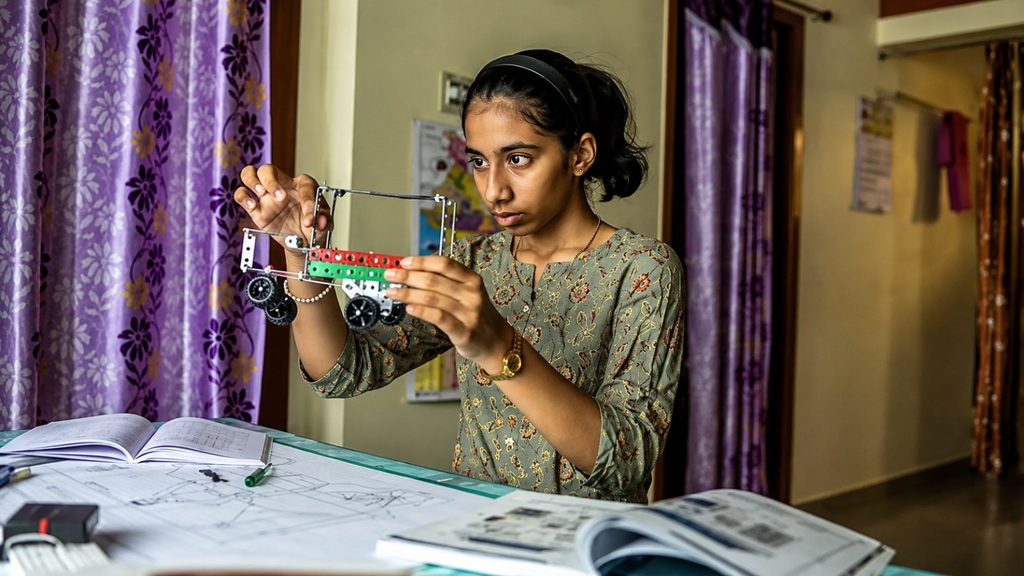
Design Thinking Starts With Noticing
Ask a student what design means, and they might talk about drawing, fashion, architecture, graphics or beautiful products.
Those are certainly parts of the design world.
But the thinking behind design often starts before any drawing happens.
It starts with questions such as:
Why does this work this way?
Who is struggling with this?
What could make it easier?
Is there another way to solve this problem?
This is what makes Vinisha’s story such a useful example of design thinking for students.
She noticed something.
She questioned it.
She explored a possibility.
And she imagined a solution.
The process sounds simple, but developing the habit of thinking this way can change how a student sees the world.

What Could a Young Student Notice Today?
A student does not need to search for a huge global problem to begin thinking creatively.
There are problems everywhere.
Maybe their school bag becomes uncomfortable when it gets too heavy.
Maybe a water bottle keeps leaking inside the bag.
Maybe grandparents find an everyday product difficult to use.
Maybe too much packaging is thrown away after opening a product.
Maybe an app requires five steps for something that should take two.
Maybe a classroom could be arranged differently so students can work together more easily.
Most of us experience these little frustrations and move on.
A designer learns to stop and ask:
“Why is this happening, and what could I change?”
That small shift—from accepting to questioning—is powerful.
You Don’t Have to Be an Expert at Drawing to Think Like a Designer
This is especially important for young students.
Many children assume they cannot explore design because they are “not good at drawing.”
But design is not only about how well someone can sketch.
Drawing is a valuable communication tool, but students can begin developing design abilities through curiosity, observation, empathy, experimentation, creative thinking and problem-solving.
Think about the different ways these abilities can appear.
A student fascinated by how everyday objects work may eventually discover Product or Industrial Design.
Someone constantly noticing cafés, rooms and buildings may enjoy Interior or Spatial Design.
A student who questions why an app feels confusing could become interested in UX/UI or Interaction Design.
Someone fascinated by sneakers, clothing and materials may explore Fashion or Footwear Design.
And a student interested in characters, stories and virtual worlds might discover Game Design or Animation.
They do not need to know the career title yet.
Their curiosity can come first.
Why Early Design Education Matters
Students are often asked about careers when they reach Grades 11 and 12.
But career exploration becomes much easier when the exploration has already begun.
Introducing design earlier does not mean asking a Grade 8 or Grade 9 student to decide what they want to do for the rest of their life.
Quite the opposite.
It gives them time to explore without that pressure.
They can observe real problems, experiment with materials, generate ideas, sketch, build simple models, receive feedback and try again.
Sometimes an idea will work.
Sometimes it won’t.
Both experiences matter.
Because design education is not simply about arriving at the right answer. It teaches students how to think through a problem and keep improving their response to it.
From an Ordinary Observation to an Extraordinary Journey
Vinisha’s story eventually became much bigger than the ironing cart she first noticed.
Her solar ironing cart idea received recognition in India and internationally, and her journey eventually took her to COP26.
But imagine removing the awards and international stage from the story for a moment.
What remains?
A young person noticed something.
She cared enough to question it.
And instead of stopping at “this is a problem,” she began thinking about “what could be better?”
That is perhaps the most valuable part of her story for another young student to hear.
Not every observation needs to become an award-winning innovation.
Not every student project needs to change the world.
The important thing is learning not to stop noticing.
This Is the Thinking Behind Design Discovery at Studio Atelier
At Studio Atelier, this is one of the ideas behind our Design Discovery approach.
We want young students to experience design not simply as a future college course or career option, but as a different way of looking at the world around them.
To observe before solving.
To ask questions before accepting assumptions.
To explore more than one possibility.
To create, test and improve ideas.
And most importantly, to become comfortable asking:
“Could this be done differently?”
Because the next meaningful design problem may not be waiting inside a textbook or classroom assignment.
It could be in a school bag.
On a phone screen.
Inside a classroom.
At a bus stop.
Or, as Vinisha Umashankar’s journey reminds us, on an ordinary street-side ironing cart.
Sometimes, the idea is already right in front of us.
We just have to learn how to notice it.
 ▶
▶
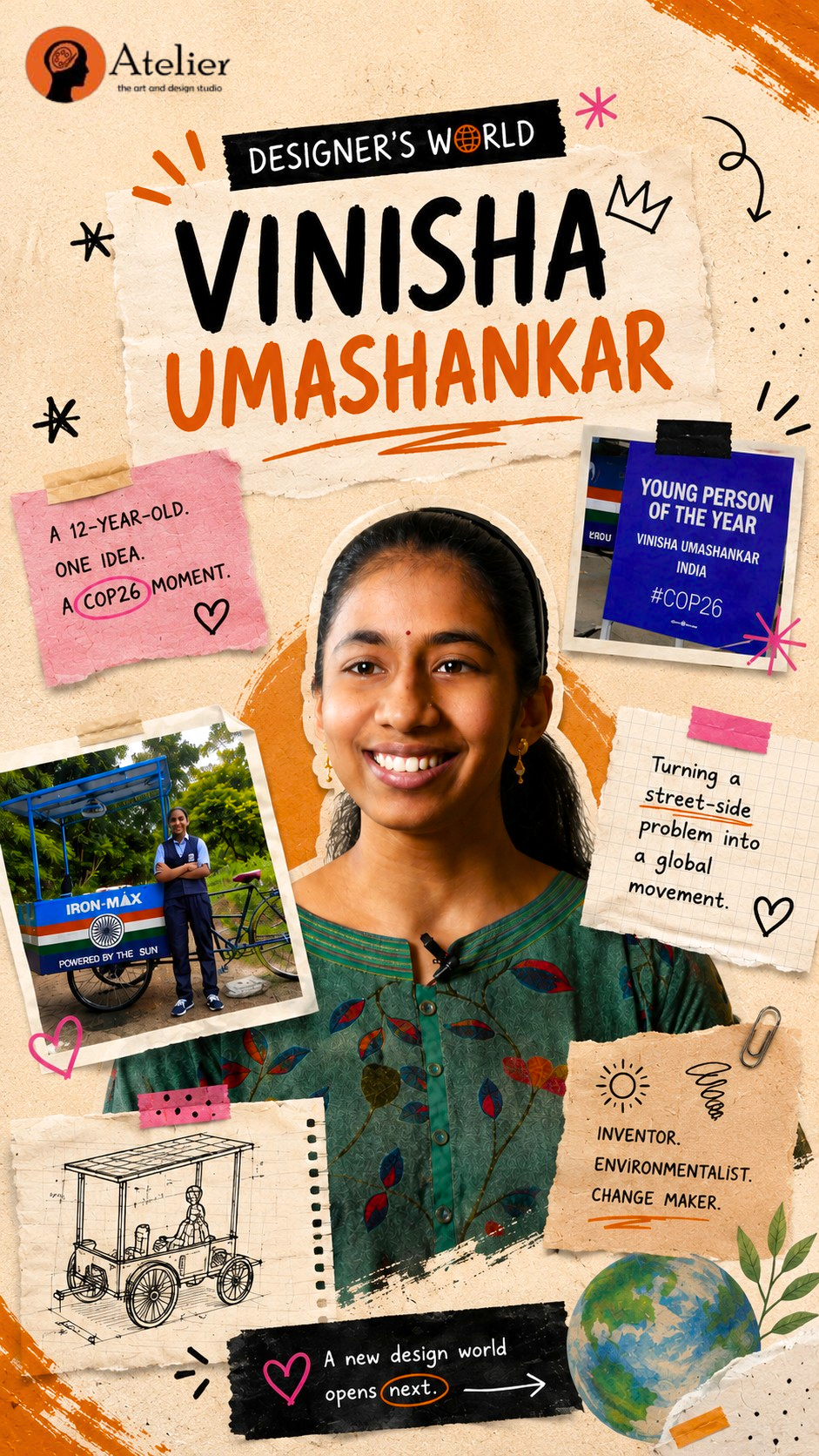
What did a 12-year-old notice that everyone else walked past?
See how curiosity and observation led Vinisha Umashankar to rethink an everyday problem and imagine a cleaner solution.
Watch on Instagram →